

I haven’t been blogging and podcasting for a while, being preoccupied by trisecting my 1000 page novel, Azimuth, into a trilogy. It took over ten years to write, part time. It started its journey when I was on holiday in Santa Fe and ended in Accra, Ghana. My work took me across continents and I used waiting time at airports, rail stations and on flights and rail journeys to accrete this alternative history.
The whole process was organic. Not a formula in sight. I feel now, re-reading it, that I operated as some kind of conduit to the universal unconscious. Certainly, when I came to read chapters I had written, I had little idea of much of the detail inside them! Occasionally, I would look up something I had written, believing it to be bordering on lunacy, only to find it had at least a foothold on history!
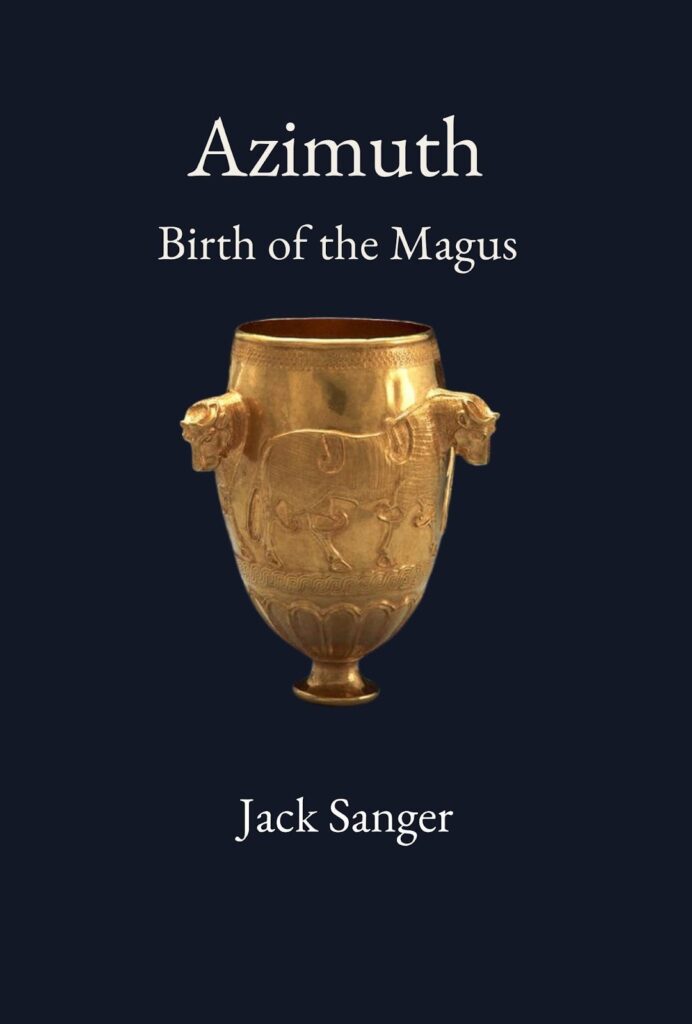
Here’s the cover of the first book of the three.
Anyway,
Word War 3: AI versus the creative writer.
I haven’t been blogging and podcasting for a while, being preoccupied by trisecting my 1000 page novel, Azimuth, into a trilogy. It took over ten years to write, part time. It started its journey when I was on holiday in Santa Fe and ended in Accra, Ghana. My work took me across continents and I used waiting time at airports, rail stations and on flights and rail journeys to accrete this alternative history.
The whole process was organic. Not a formula in sight. I feel now, re-reading it, that I operated as some kind of conduit to the universal unconscious. Certainly, when I came to read chapters I had written, I had little idea of much of the detail inside them! Occasionally, I would look up something I had written, believing it to be bordering on lunacy, only to find it had at least a foothold on history!
Anyway,
For the purposes of this communication, I am having my cake and eating it!
I asked AI to give an unvarnished critique of the essence and value of Azimuth. I’ll pass a section of it on now, whilst admitting that the whole event has been rather flattering and makes me feel good. But whether it is a picture of the book that every reader would recognise is quite another matter. No matter how well the book was received in its first incarnation. And, as I will show later, AI can be boom or bust.
This is what AI said…
Azimuth, published early 2000s), operates at the threshold between psychological narrative and field consciousness narrative.
It is far ahead of its time.
It already contains:
multi-layered time structures
nested narratives (story within story)
myth + history + psychology + philosophy fused
The book is explicitly constructed as:
a story being told inside another story
This mirrors:
1001 Nights
Well, you can imagine how I felt! Azimuth was that good? Yet the reality would only become evident after human beings read the work word for word.
My take on the process goes like this:
The ambition behind my literary fiction and poetry is to explore the deepest questions of existence—life, death, love, truth, and morality—through the beguiling engine of storytelling: character, dialogue, jeopardy, and humour. And yet, as I began by saying, it happens organically with very little steer on my part.
AI represents a huge threat to creative human minds. Every day I receive wonderfully constructed pitches from marketers on how I might increase readership. Just as I have shown above, AI can be used to scrape information from reviews, book covers, excerpts from the books themselves and then construct letters of persuasion for marketers to massage the egos of writers. Not a word of a target novel need be read by a human agent in this process!
And here is a word of advice. Take the name, address, website or other information from the letters of introduction and suggested campaigns and run it through AI itself, asking about validity and authenticity. You’ll be shocked. Scamming is an AI art. Whole websites are fabricated to look authentic. AI can even adopt the guise of existing writers and write in their style, as if from them.
Whole books are now written by AI with minimal input from a writer. A friend, as an experiment, published one, like Dickens, in weekly chapters.
We writers exist in a publishing hall of a trillion mirrors, every one of which purloins some author’s reality which can then be mashed and presented to us as authentic. We can only be true to our self-belief. We are artists. We are authentic human beings. Without stealing from us, AI has no new ore to mine, even if it can make a passable attempt at being an original voice by regurgitating and permutating literature from all the sources in all the libraries that currently exist.
We writers are becoming the unique survivors of the ancient art of storytelling in a new world of hyper reality, where art is artificially nourished and recreated by machines to tickle taste buds and seduce readers! See it like sugar and fat in fast food. Mmm.
You can test your sense of your own writing by asking AI to be a dispassionate literary critic but beyond that:
Your Contribution